As previously mentioned, I am slimming down my console collection, but its not going to happen as quickly as I initially thought. Most of what I sell is sold on eBay, and I have a ton of material (mostly old CDs and Role-playing books) that need to be sold first, so I will be hanging onto my consoles for a little while longer.
Still the only TV I have left to play on is the old B&O in the loft. The other current gen consoles have been distributed or will be distributed around the house in various forms, mostly serving as a Youtube portal or Netflix device.
Hand Helds - I am selling the PS Vita as it doesnt really earn its keep, and I expect to get back what I paid for it. I will be keeping the Nintendo 3DS for now as it has an R4 card and access to unlimited games, all it needs is a new battery.
Retro Consoles - The Megadrive and Gamecube are going to be the first 2 consoles to go as I dont feel any love for the Megadrive, and what games I do want to play, I can managed perfectly well on the Raspberry Pi. The Gamecube was more of a novelty as my Nintendo Wii plays all the Gamecube games without a problem.
The next batch would be SNES because of a lack of access to games, and both the Dreamcast and Saturn for the same reasons. For now I will be holding onto the Nintendo 64 and Playstation as both of these are earning their keep as emulation isnt great yet for either machine.
Modern Consoles - here comes the tough choices. The Playstation 3 is in the lounge, and the Playstation 4 is in the master bedroom, which leaves me with the Wii U, 2 Nintendo Wiis and the Xbox One.
I have configured one Wii to run Wii ISOs and the other to run Gamecube ISOs meaning I can sell off any unwanted Gamecube games I have on ISO. The Wii U will most likely join the Playstation 3 or 4 and the Xbox One the same.
The final console choice is going to be where I put my Xbox 360, as I have too many Guitar Hero/Rock Band stuff to just sell off.
I will keep what I can in the loft and use the CRT TV, and maybe sometime down the road buy another LCD TV.
Thursday, 21 January 2016

Adventures in Gaming Part 8
Although I did learn the basic functions of programming BASIC, I never did anything with it, until I had to study and take my Computer Science ‘O’ Level qualification at school. In that class I had a choice of producing a mixture of four different computer projects, either a computer program or a written report about the computer industry. The written essays were nothing more than how the introduction of the microcomputer will influence various aspects of our lives and the prospect of writing an essay just seemed boring and predictable, so I choose to write four computer programs. The first program I wrote was an incredibly limited and basic Word Processor. I had already done something similar on my BBC computer at home, so I just copied what I had already done. I naively and mistakenly thought it was of commercial quality. The second program I wrote was a simple dice rolling program, but I can't remember what the other two programs were, most likely I copied the code from other people’s efforts. I know I wrote one of them in an afternoon just to complete my coursework. There were several people who wrote some very competent versions of Atic Atac and other well known games on the Spectrum using very simple two dimensional matrix arrays. I was far too lazy to get anything like that going. I was more interested in pen and paper role playing games, reading books and listening to music as well as playing games to writing them. Looking back it might have been a good thing to have started a proper computer club at school and have started our own small company, there were enough smart guys. During my O Level years at Westbourne we did have three Sixth Form computer science students who had done just that, written simple games and were looking to publish them.
At our school the computers we used were LINK machines. I had never heard of them before and have never seen them since. They were horrible black metal monsters with small monochrome display monitors and limited graphic potential. It could draw and display simple lines, which was how my friends programmed a very simple rendition of Atic Atac on it. He accomplished this through a set of databases that could draw objects based on matrix values, and would compare adjacent values so it could draw a wall or another door. In a regular class of thirty children, there were only sixteen computers available, meaning you had to share. I was always curious, but we were given secure storage space for our programs on these school computers on the B:\ drive. I knew there was a hard drive at school which was a monster, but I was far too curious about what lived on the A:\ and C:\ and D:\ drives. The school kept a lot of routine documents there, but nothing incriminating, sadly. Our computer science teacher was an unlikeable fellow who clearly hadn't made an impact in the computer industry himself and chosen to become a teacher as a last resort. His answer to any question we asked in class about programming was met with one single answer. “Read the manual”. His other smart arse response to a stupid answer to a normal question or a stupid question asked in the first place was “Engage brain before mouth.” Its interesting that Read the Manual would later become an internet meme that became Read the Fucking Manual. I think had he been more nurturing I would have embraced programming more, but this style of teaching method appears to still pervade today.
As previously mentioned, I was lucky in that apart from a few driving games, my brother wasn't that interested in playing computer games, partly because he wasn't very good at them and partly because he had a social life outside of school. It was because of this I pretty much got to dominate the usage of his ZX Spectrum 48k+. Those games he did enjoy were on the Commodore 64 he played only when I let him. He did find fascination in playing driving and car-related games on the Spectrum like New Wheels John by Automata, an open-ended second hand car dealership game where your job was to take car wrecks and repaint and repair them for sale at vastly inflated prices, and Turbo Esprit by Durrell Software which was a mission based three dimensional driving game, but also allowed you to sandbox free-driving around the cities as well where you had to obey the traffic lights and one-way traffic systems. There was very little penalty in not obeying the rules of the road. It was years ahead of games like Grand Theft Auto and Driver on the Playstation console.
The two most important ZX Spectrum games to be released in the early days was Manic Miner and Jetpac. Both of these exclusive Spectrum only games defined the computer. Manic Miner was an excruciatingly difficult game that required pixel perfect jumping and timing. It only had twenty static levels, and even with infinite lives I only ever managed to get to see up to level fifteen, so how the hell you were meant to accomplish this with only three, no one knows. It required perfect timing and pixel perfect jumping.
Tuesday, 19 January 2016
4 Gaming Documentaties on Netflix
I recently got a Netflix trial subscription and started watching some films I had been meaning to watch, but then turned my attention to some gaming related documentaries.
Bedrooms to Billions. What stunned me most about this was that the entire narrative came from the people being interviewed and not any narration. I did crave for more in depth information about companies and individuals and hopefully the creators (who are currently making a sequel about the Amiga Years) will make more films. One thing it did help me understand was how and why the British game industry died, and it was down to lack of government grants and assistance.
Atari: Game Over. I knew of the home console crash in the early to mid-1980s, but it affected the industry more than the retail sector, and by then I was already engrossed into the UK computer scene, but it did reveal that while E.T. was a poor game compared to its contemporaries, it wasn't the sole reason Atari and the industry failed wholesale.
Indie Game: The Movie is a story about 3 independent development teams on the way to releasing their long awaited indie game. What was most telling about the film was how neurotic and paranoid and obsessive some of the these programmers are, how difficult they are as human beings to relate to, and how they view success and failure in totally different ways to normal people. They are both fascinating and frustrating to watch in the interviews.
Downloaded. I have just started watching this, but it is a stunning portrayal of the events that blew the internet and music industry wide open and turned the internet from a data viewing and storage system into a global communications tool, as well as a global sharing medium. Watching this left me with nothing but resentment for the people blocking progress, and resolved even more to never buy music again, but support the smaller bands.
Friday, 15 January 2016
Adventures in Gaming Part 7 - The Magnificent Seven or Eight
I didn't realise it at the time, but I think Wizball is probably the best shoot em up game ever released on the Commodore 64, and probably the best and most original shoot em up game of all time. I know the Commodore 64 was home to some high quality shoot em ups, such as Uridium, Delta and Sanxion, but Wizball was very successful and only received acclaim many years later. It was ported to the other home computers, but none were as perfect as the Commodore 64 original. I knew of it through ZZAP64 magazine where it got a Gold Medal status review, but the screen shots although impressive, I found it initially confusing to see what it was that you were meant to be doing in the game. Because it got a Gold Medal it must have been something special. I eventually got hold of the game on an Ocean Software compilation called The Magnificent Seven, but with a bonus game making it eight. Both Ocean Software and US Gold had excellent reputations when they produced compilations by ensuring there was as little filler as possible. 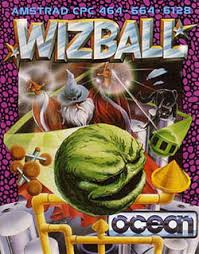
Wizball was created by the inappropriately named Sensible Software who had a reputation of producing excellent games up until this point. Also instead of being a one man outfit, Sensible had two members. Wizball had an original colour mixing mechanism, a clever two player mode and was a real challenge to play as well. No conversion ever came close to the original. I remember the Amiga version being a shameful copy of the way the game looked and graphics, but failed to emulate any element of the gameplay whatsoever. Ocean did a shoddy 8 bit and 16 bit versions, it was only the Commodore 64 version programmed by Sensible Software that really was the best. Wizball was a sublime blend of game styles spread over eight levels. It required a lot of skill and a fair amount of strategy. Each stage produced enemies and coloured drops of paint of a certain colour. You could move between each stage collecting and mixing colours to finish the level. Each level required three sets of different mixture of colours to finish the level. Completed levels would open up new levels later on, while completed levels became “dead” of enemies and no longer produced colour drops. Each of the later levels became more difficult, so the strategy was ensuring you didn't complete and close early levels as they would help you finish harder later levels. Once a level was completed it no longer produced coloured paint. When you began the game you had a bouncing ball that slowly got easier to control as you collected power-ups. Then it became a power-up session wherein you built enough power in your Wizball to own a cat, or ‘Catellite’, which would collect the coloured paint that was dropped after shooting enemies. The Amiga version was not programmed by the same team, but they did do a sequel called WizKid which I didn't enjoy as much. In the single player version you controlled both the Wizball and ‘Catellite’, which was a challenge. In the two-player mode, the second player played the cat and made for a more enjoyable experience. One clever element was the idea that you could either boost the Wizball or the ‘Catellite’ not both. So you really needed to work as a team. It also benefited from a beautiful and ethereal opening music track, and even had an impressive electric guitar solo ending when it was game over all composed by Martin Galway. This was a far deeper game than it appeared to be and ever got credit for. It wouldn't be until the release of Shadow of the Beast 2 would a game over guitar sound as good as this. There was a remake done by Graham Goring in 2007 that would emulate the perfection that was the Commodore 64 version.
The seven other games in the inappropriately named Magnificent Seven compilation by Ocean Software were Cobra, an average side scrolling platform shooter based on the then current Sylvester Stallone movie, Frankie Goes to Hollywood, a genuinely original arcade adventure set in a suburban town that was weird and original that didn't seem to have any immediate goal programmed by Denton Designs, The Great Escape, an isometric game similar to Knightlore but required planning to escape also programmed by Denton Designs, Arkanoid, a breakout reboot that I disliked because I don't enjoy Breakout games, Head Over Heels, probably the finest isometric arcade adventure on the Commodore 64, Short Circuit, a side scrolling arcade adventure based on the movie, and the eighth game was Yie Ar Kung Fu, an over-the-top one or two player fighting game. This was a fantastic package of quality games for one price. I didn't enjoy Arkanoid, Cobra or Short Circuit much, but the other five were exceptional games for the money.
Some of the other original games for the Commodore were stunning, such as Forbidden Forest and Aztec Challenge, Boulderdash. Neither of these games were released on any other computer other than the Commodore, so you either played them on the C64 or not at all. Games that were ported over from the Spectrum were poor clones of original version. A lot of classic Spectrum games never arrived on the Commodore and vice versa, and most notably were the Ultimate Play the Games games. It finally began to make sense to own both computers as each of their unique games played to the strengths of the machine.
Although the Commodore 64 was home to some of the greatest computer games and computer music of the 8 bit era of the 1980s, I felt I was still missing out on the most popular computer of the time, the ZX Spectrum. Everyone at school seemed to own the Spectrum as it was a far cheaper computer. The ZX Spectrum came out of nowhere to become the single most popular and important home computer of the 1980s. It was incredibly cheap and the proliferation of software for it immense, and because it had a huge array of games (both quality and crap in equal droves). The ZX Spectrum came in two varieties, the 16 and 48k version. There was very little money between the two models, but most of the software released was exclusively for the 48k model. In a matter of a few months it seemed everyone at school owned a Spectrum, and the piracy scene at school was unprecedented. Games were easily copied tape to tape or with many of the easily available copying programs.
When my brother finally decided he wanted a computer as well, I was the one who made the choice on which machine it would be. He was bought a ZX Spectrum 48k+ for his birthday, but it lived in my bedroom, as I was the only one with a spare television. The ZX Spectrum 48k+ was exactly the same as the regular ZX Spectrum but it had a proper keyboard and built in joystick ports meaning it was less prone to crashing or falling apart. With the ZX Spectrum I was exposed to the whole new piracy scene at school, and quickly amassed a huge collection of games in a matter of weeks. Games were traded as easily as music. I stored mine on C90 audio cassette tapes, and whole weekends would disappear whilst going through friend’s tapes. Copying games for the Spectrum was far too easy, you either did it via tape to tape or using one of several copying programs, most notably The Key. My brother’s computer came initially with only one game, PSION Software Tennis, which was a pretty decent version of the game. That game was enough to trade my way up to accumulate a large collection. I remember going around a friends house and within thirty minutes I had a reasonable collection of unknowing classics. The price of games on the 8 bit computers was so cheap, that buying a good game wasn't an issue, plus with both budget software companies (and later re-releases) and big name compilations were becoming common place. Copying games was easier than buying them. Everyone at school who had a computer had a ZX Spectrum because they were cheap and the machine incredibly powerful. It had limited colours and it sounded horrific as well as suffering from “colour clash”, an effect where sprites on a certain colour would bleed colour all over the screen onto other sprites they were passing. It required an add-on to be plugged into the back of the machine to allow you to use a joystick with it, but the games, especially all those by Ultimate Play the Game’s early games like Atic Atac, Jetpac and Sabre Wulf were terrific and hard. Games were hard, and mostly only had limited levels because of memory issues, so games like Manic Miner had twenty of the hardest levels, and even with infinite lives took me ages to get to the later levels, and I still didn't manage to complete it. Piracy on the Commodore 64 was harder as I didn't know anyone with a machine. I only owned a few original games on the Spectrum, mostly second hand or budget and re-releases of games I wanted but never found.
Its amazing to think back to that time with every game almost being a classic and here we were as teenagers unaware of how important these games were to building the industry.
The Sinclair Spectrum had its own form of BASIC called Sinclair BASIC. This was a version of the popular BASIC language, but taught you many bad programming bad habits and poor syntax. What was special about the ZX Spectrum was that each key on the keyboard served many functions and each key was covered by what looked like a confusing array of functions helped only by the colour coding. I never programmed the Spectrum at all. I did buy many joysticks for it, as did pretty much everyone I knew. Odd that I still prefered the keyboard when given a choice, but it makes sense when I think about how quickly I took to Doom using the keyboard, and that it took many years before I’d finally accept keyboard and mouse as a better option, but only because games started to use Mouse Look as an option from Quake onwards.
I later found out one of the reasons why the ZX Spectrum was able to be sold so cheaply, and hence became more successful in terms of numbers, was that it cleverly used failed components from other hardware manufacturers. For example, the ZX Spectrum came with 48k of memory, in three lots of 16k memory blocks. Each of these 16k memory blocks was in fact 48k ram of memory that was defective, and limited to just 16k. Had they not been used, these failed memory chips would have simply been discarded.
Thursday, 14 January 2016
Slimming down the Collection
I have decided to slim down my console collection as it is dominating too much of my space in the loft and is way too distracting to boot.
I have relocated all the big-boy consoles to other locations in the house as they service as Youtube and Netflix devices, and the rest will earn their keep or be sold off.
First up for sale will be my Megadrive. I did own this new, and recently rebought it, but sadly I discovered the unit is Mono only, and only the Megadrive 2 came with stereo sound. I recently bought a Megadrive 2 and felt no compulsion to own it.
I have relocated all the big-boy consoles to other locations in the house as they service as Youtube and Netflix devices, and the rest will earn their keep or be sold off.
First up for sale will be my Megadrive. I did own this new, and recently rebought it, but sadly I discovered the unit is Mono only, and only the Megadrive 2 came with stereo sound. I recently bought a Megadrive 2 and felt no compulsion to own it.
Thursday, 7 January 2016
Handheld Consoles Still Relevant
I havent had much chance to play my big consoles over the last few days, but I have kept myself busy in the evenings playing on my handheld consoles, Playstation Vita and Nintendo 3DS.
On the Vita I have been playing the usual free monthly games because of my Playstation Plus subscription, and on the Nintendo 3DS I have been playing Lego Star Wars, the complete trilogy and more recently Phoenix Wright, Ace Attorney.
On the Vita I have been playing the usual free monthly games because of my Playstation Plus subscription, and on the Nintendo 3DS I have been playing Lego Star Wars, the complete trilogy and more recently Phoenix Wright, Ace Attorney.
Tuesday, 5 January 2016
A couple of Retro-Consoles just have to Go
I have decided that I am going to sell a couple of the retro consoles I recently bought.
The Nintendo Gamecube is going because I have a 2nd Wii for the children, and if need be I can use the Wii as a Gamecube as I intend to keep the controllers. I am also investigating the possibility of running Gamecube ISOs on the Wii using homebrew, meaning I will be able to sell my small collection of Gamecube games as well.
The other console I have decided to sell is the Megadrive. The reason behind it is due to my lack of connection to the console. I love the SNES, I love the Saturn, I just don't feel the same passion for the Megadrive. I am happy with a Raspberry Pi running it under emulation, as it runs at the proper speed rather than slowed down for PAL.
I have also decided to sell off a couple of Nintendo 64 games as I already own them on the Rare Replay collection on the XboxOne.
The Nintendo Gamecube is going because I have a 2nd Wii for the children, and if need be I can use the Wii as a Gamecube as I intend to keep the controllers. I am also investigating the possibility of running Gamecube ISOs on the Wii using homebrew, meaning I will be able to sell my small collection of Gamecube games as well.
The other console I have decided to sell is the Megadrive. The reason behind it is due to my lack of connection to the console. I love the SNES, I love the Saturn, I just don't feel the same passion for the Megadrive. I am happy with a Raspberry Pi running it under emulation, as it runs at the proper speed rather than slowed down for PAL.
I have also decided to sell off a couple of Nintendo 64 games as I already own them on the Rare Replay collection on the XboxOne.
Subscribe to:
Posts (Atom)